
Back in December, I joined Brent Summers, Staff Manager, Marketing at Qualcomm Technologies and the Association of National Advertisers for an exclusive session sharing our perspective on where ABM stood in 2025, and what to expect going forward – both as long-time practitioners and senior decision-makers.
We covered a lot of ground, and I’ve distilled it down into five key areas that, if addressed, can help create a competitive moat and keep ABM working for you over the next 12 months or so.
Investment > capability = skills gap
Now, this is a common challenge we’re seeing both amongst our clients and across the industry: businesses are increasing their investment, but it’s still reliant on a small group of ABM specialists.
What once benefited from a lean, specialist team has suddenly become a bottleneck for the breadth and depth of capability needed to run more programs.
Most organisations haven’t industrialized ABM skills across Sales and Marketing. And it’s not just the scale of capability, it’s the range of skills needed for any ABMer. There’s an increasing demand for hybrid profiles– people who understand, amongst other things, Strategy, Data, Content, and Sales motions.
ForgeX reports that 64% of B2B businesses expect to increase ABM investment in 2026, yet only 56% feel prepared to meet the year’s challenges.
Worryingly yet, only 7% feel very confident in their ABM skills and training.
To begin to address this capability gap, you’ll need to objectively assess your current situation, you and your team, their skills, and experiences. Ask yourself three simple questions:
1. Where do you – and more importantly, don’t you – have the skills, tools, or capacity to execute well?
2. Which gaps can you fill in-house, and where do you need a partner?
3. What qualities or DNA do you need in a partner?
When contemplating what kind of partner you need, Brent’s nugget of wisdom could do you wonders:
Consider whether you’re looking to operate or innovate. Are you experimenting with something new and trying to pilot it? Or are you looking to scale what you already have? Using that lens in evaluating a partner will make a massive difference to the outcome.
The AI elephant in the room
At this point, the elephant isn’t in the room; we’re in the elephant sanctuary. AI has become so ubiquitous in our industry such that, according to ForgeX STUDY NAME, 91% of B2B marketers have adopted AI to support ABM.
The majority of AI use-cases center on copywriting (66%), research (47%), and predictive analytics (46%).
A lot of organizations are just starting their AI journey, and the numbers reflect that. Writing, research, and at points, analytics are examples of single-focus tasks.
If you’re in this camp, you’ll soon wonder how to take a whole workflow – not just a simple task – and run it supported by AI.
For market-leading adopters like Qualcomm Technologies, it’s meant moving AI from single-task optimization to workflow transformation. Brent mentioned using advanced, interoperable platforms has allowed them to build an express “swim lane,” allowing teams to avoid encroaching on human-oriented workflows while reaping the benefits of increased efficiency.
Don’t let your team become an extension of their tools. As Brent put it:
“You’ve got to balance what you automate and scale today vs. the promise of the technology.”
For us at Transmission, we created Story Engine – an AI-enabled offering that audits at scale, collects, and analyzes content against an established customer journey or content framework. This gives us the foundation to run a gap analysis and absorb client messaging to create the groundwork for a gamut of content.
But the key caveat in both of our cases is to never leave the AI tool to its own devices.
Identify which decisions you’re comfortable being made by a human, and what you’re happy to leave to the algorithm. Yes, AI can help you move from 1:Few to 1:1 by offloading the intense resource necessary to run a hyper-personalized program – and faster too. But we also don’t want to miss out on those uniquely human insights that create genuine engagement.
Ask yourself:
If automation is all you need, do you even need an AI tool?
What AI use-cases will make the biggest difference to your program? Avoid ‘me-too’ AI
Where do you draw the line between human and algorithmic decision-making?
Fix account selection
Having the right skills or the right MarTech stack means nothing in the face of poor account selection. Unfortunately, many organizations still struggle with this in B2B. Believe me, I’ve seen so many scenarios where opportunity was the deciding factor for selection – all the while ignoring poor relationships, recently signed competitors, or a non-existent Sales and Marketing relationship. Account selection needs discipline.
Here’s a three-step approach that can help you identify which accounts to prioritize so you can avoid the same mishaps:
The right account is your ICP
The best ABM is cross-functional. That means working with Sales, Customer Success, etc. But how often do you really sit down to define what your Ideal Customer Profile (ICP) looks like? There are times it’s implicit in your organization and based on current account lists. But there are also times when you need to make it explicit.
Only 40% of ABMers have a ‘very well-defined’ ICP. Nearly half describe their ICP as only ‘somewhat well-defined’.
Mature programs run structured account selection and prioritization processes instead of using ad-hoc targeting lists.
Yes, you have to work with Sales for the best outcomes, but it shouldn’t come at the cost of poisoning the well from the outset.
Go for immediacy next
Think first- and third-party intent data. Marketing feedback, website feedback, prediction models. Use every signal available to you to narrow down your ICP into the businesses that are either in-market or coming into market soon.
Run an ABM readiness assessment
This is an especially important step when you’re at the 1:1 strategic level of ABM. You need to consider the opportunity, but at the same time, understand the nature of the relationship and any complexities involved.
We call this readiness. Whatever you call it, it’s the idea that what appears to be the best account may not be the best account right now.
Moving away from the MQL mindset
The short of it is, ABM’s fundamentals haven’t changed much over the last 20 years. Where we see the need to develop and retain accounts that are important to us, the initial goal has – and should always be – to build relationships. That’s the pathway to pipeline and revenue.
It’s a simple idea, but one that often hits the hurdle of MQLs. In all fairness, MQLs still have a role in demand-based marketing initiatives. What we need to see is an acceptance that if we’re going to engage accounts, we need to use different measures of success.
Otherwise, ABM programs run the risk of becoming demand generation in all but name to satisfy the insatiable MQL goal.
40% of B2B deals stall due to internal misalignment.
The cause? Hidden buyers who significantly influence purchases, even if they aren’t the primary user.
This is a growing trend in B2B, and a challenge the MQL mindset can’t address: buying groups are growing, and committees are becoming more complex. We need to engage.
Adopting buying group and intent signal-based engagement for both conversion and win-rate has been proven to outperform traditional MQL-based models.
Notice how I say ABM’s core goal is to build relationships. The best programs are those that focus on the customer lifecycle across acquisition, retention, expansion, and advocacy. MQLs represent a demand-based mindset that neglects the other needs of happy customers.
Brand as the great amplifier
Once you accept that engagement needs to play a bigger role, ABM becomes so much more effective at a brand level. Using approaches like brand storytelling to capture imaginations, and elevated customer stories to engage, puts you in the minds of decision-makers long before they enter the market – laying the groundwork for them to come to you once they are.
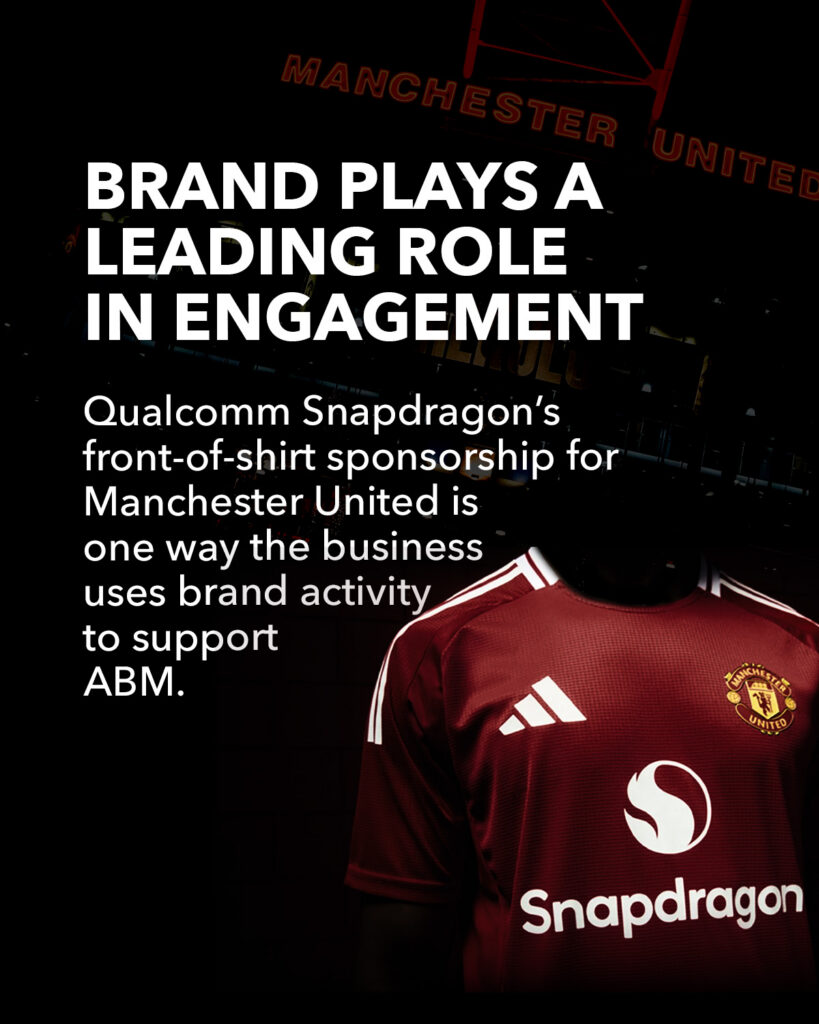
Brent brought up the Snapdragon front-of-shirt sponsorship for Premier League giants, Manchester United as one way the business uses brand activity to support its ABM efforts.
Global visibility and the associations that come with it have a very real impact on brand perception – and being able to invite prospects to a game adds an experiential element to what can be a very digital approach.
But you don’t need to go as big as the Premier League to invest in brand. As I’d mentioned earlier, elevated customer stories like talking heads videos give your customers a platform to share their experiences. B2B buyers are more receptive to Tailored Social Proof, and are 43% more likely to trust industry-specific social proof than generic claims. In the end, it’s all about giving your audience a reason to remember you.
To wrap…
ABM feels like it’s an idea that has matured for most organizations. Increased funding is shaping how the landscape is set to look over the next 12 months. And it’s the businesses that quickly identify their gaps and how they’re going to deal with them that will stay out ahead.
Looking for tailored guidance for your ABM activity in 2026?
Reach out to learn where to find opportunities to impact your ABM approach.